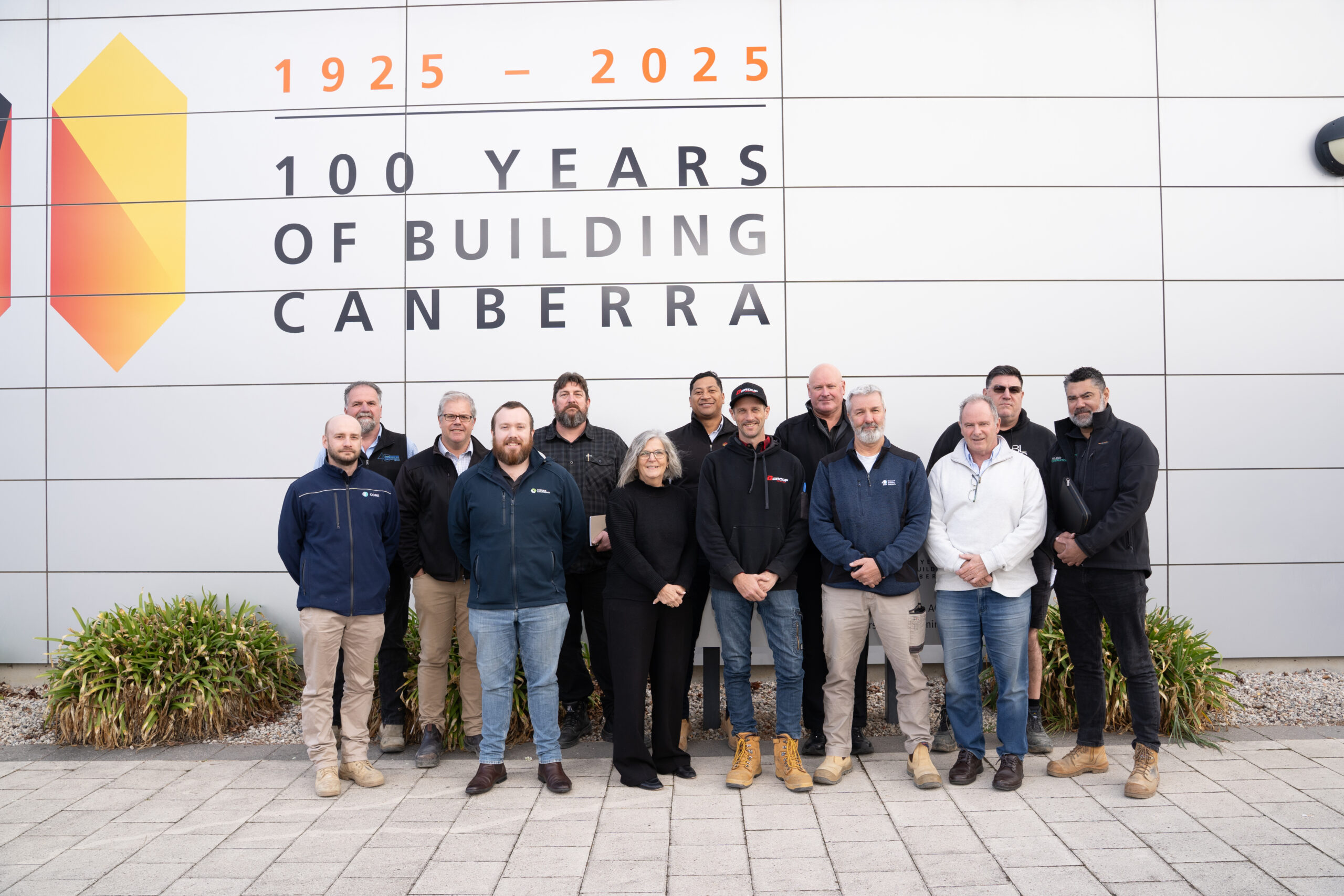
Antony Wilson – HSE Manager for Elevated Constructions – local builder for 16 years.
Antony is a born and bred Canberran who is proud to work for a local commercial and residential construction business. He has been working in construction safety for 16 years and is focused on building a collaborative and educational approach to managing the many hazards that our industry presents.
Last year Elevated Constructions made the decision to apply for certification from the Office of The Federal Safety Commission considering the additional work available under the HAFF program. OFSC accreditation has traditionally been more focused on the purely commercial side of the industry, however with the Federal Government committing $10 billion to fund social and affordable housing, and government funded work requiring OFSC accreditation, the requirement for accredited builders has expanded.
I was fortunate in having gone through the OFSC audit process several times with previous employers, so I had a reasonable expectation of what the audit process involved. However, starting the accreditation process was a new experience for me, and Elevated as a whole.
What the OFSC is:
The Office of the Federal Safety Commissioner (OFSC) administers the Australian Government WHS Accreditation Scheme, which applies to Commonwealth-funded construction work.
What the HAFF program is:
The Housing Australia Future Fund (HAFF) is a $10 billion Australian Government initiative established in 2023 to fund social and affordable housing.
- Target: 40,000 homes (20,000 social + 20,000 affordable) over ~5 years.
- Delivery: Through grants, loans, and partnerships with government, community housing providers, and developers.
- Objective: Increase housing supply and address acute housing need (including vulnerable groups).
To meet the demand for additional builders (especially builders more focused on residential development) the OFSC was given additional funds to fast track the accreditation process. The money is directed towards making FSOs (Federal Safety Officers) more accessible to builders with up to 40 hours available through the process.
Accreditation Process:
Stage 1 – Complete application
- Create online account
- Provide safety system including how it addresses each of the OFSC criteria
- Information about company operations
- No fees or charges to apply for accreditation
- Once your application is submitted, the OFSC will check all required information has been provided and contact you if there are any gaps. The OFSC will then triage the application based on the likely contract date for any building work and allocate a Federal Safety Officer to begin auditing of the WHS management system and practices against the Federal Safety Commissioner’s Audit Criteria.
- You will also receive a request from the OFSC to submit:
- a declaration the builder will comply with the National Construction Code (NCC) where applicable to any work it undertakes, and
- further information about the builder’s previous WHS performance.
The key element of the application process was to supply a gap analysis of how our Safety Management System addressed the OFSC audit criteria, demonstrating how we have a documented process for managing each of the risks identified.
Stage 2 – Systems validation audit
- Once your application has been processed, the OFSC will contact you to arrange a Systems Validation Audit to assess the company’s WHS Management System against the Federal Safety Commissioner Audit Criteria. For Elevated, this system validation audit was conducted online.
- Following the systems validation audit, you will be provided with a detailed report describing where the criteria has been met and detailing any gaps that have been identified. The report is usually provided 5-10 business days after the audit.
- The Systems Validation Audit will result in one of the following outcomes;
- The head contractor builder’s documented safety system is assessed as suitable to progress to an on-site accreditation audit; or
- Gaps in the documented safety system are identified such that the head contractor builder does not demonstrate adequate compliance with the FSC Audit Criteria to warrant an onsite accreditation audit.
- In the case of outcome 1 and noting that 100% compliance with all systems validation audit criteria is not required to proceed to an on-site audit, a rolling systems validation audit may be implemented with the view to reducing the number of potential corrective action reports arising from the on-site audit and increasing the likelihood of the applicant achieving accreditation.
- In the case of outcome 2, a rolling systems validation audit will be implemented to assist the head contractor builder to identify and remedy system gaps so they can proceed to the next step in the accreditation process as quickly as possible.
- The Federal Safety Officer who conducted the audit will be available to the applicant to:
- debrief applicants about the system gaps that have been reported on in greater detail.
- answer questions the applicant may have about the gap findings.
- provide general de-identified examples on what accredited companies have in place to meet Federal Safety Commissioner Audit Criteria.
- direct applicants to available resources (e.g. industry and regulatory publications, tools etc).
- review updates made to WHS management systems and processes and confirm whether the updates now meet the Federal Safety Commissioner’s Audit Criteria.
- The ongoing support will be arranged between the OFSC, Federal Safety Officer and the head contractor builder. Federal Safety Officers can provide up to 40 hours of support to applicants as outlined above. The 40 hours is the time spent by the Federal Safety Officer to prepare, support the applicant and undertake follow-up administration. It does not include time spent at audits. This support is not a consulting service and Federal Safety Officers are unable to advise on, or draft, WHS management system revisions.
At Elevated we progressed through the rolling systems audit process with our FSO to close out the gaps identified at the validation audit stage. Being able to contact the FSO directly and have him help clarify some of the expectations for system criteria was invaluable.
Stage 3 – On-site Accreditation Audit
- The On-site Accreditation Audit will be held at a project where the head contractor builder is the Principal Contractor and where its WHS Management System is in place.
- At the On-site Accreditation Audit the Federal Safety Officer’s focus will be to verify the implementation of WHS procedures and practices on-site.
- In the case of the applicants that have received the rolling systems validation audit support (refer above to Stage 2: Systems Validation Audit), the on-site accreditation audit will focus on confirming the on-site implementation of the documented WHS management system. This audit will not re-assess the head contractor builder’s WHS management system in relation to issues already audited and addressed through the systems validation audit and post- systems validation audit rolling analysis referred to above. For any system gaps that remain open following the systems validation audit and post- systems validation audit rolling analysis, the Federal Safety Officer must review both the documented system and the onsite implementation of the processes required to meet the FSC Audit Criteria.
- The on-site accreditation audit will likely review implementation of:
- Work Health and Safety Management Systems (WHSMS) criteria;
- Focus Point criteria; and
- 1-2 x Hazard criteria may be selected from hazard criteria most common to head contractor builders including Mobile Plant, Work at Heights, Electrical, Excavation and Temporary structures (depending on project stage and works occurring).
- Following the on-site accreditation audit, you will be provided with a detailed report describing where the criteria has been met and detailing any non-conformances. The report is usually provided around 10 business days after the audit.
- The Federal Safety Commissioner makes the final decision on whether to grant accreditation, taking into account the findings of the on-site audit.
The onsite audit process was smooth with focus being on how our system was implemented on site. Having the same FSO engaged for the whole process definitely made a big difference in being able to satisfactorily meet the criteria.
Overall, the accreditation process under the HAFF fast track process was very smooth and the additional help offered through the dedicated FSO was great. Having a consistent point of contact and perspective through the process made a huge difference, and made the job of navigating the process far easier.
IF you are thinking of participating in the HAFF program and have questions or want to know more about the process from a builders perspective, you can contact Antony through the ACISRG