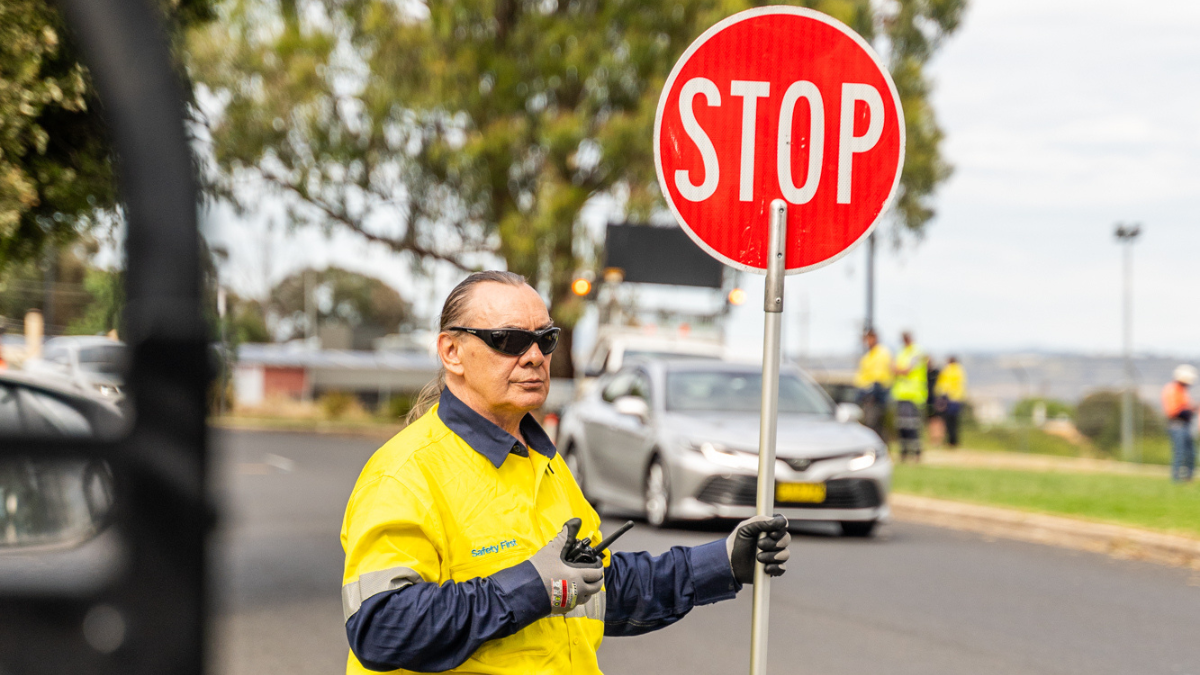
National Road Safety Week puts a spotlight on what happens on Australian roads, but many of the same risks exist every day around construction sites, civil works and temporary traffic zones.
The numbers are hard to ignore. In 2024, 42% of all worker fatalities in Australia involved a vehicle. Construction accounted for 37 worker deaths, with reversing incidents remaining one of the most common types of worker-related crashes.
Most of these incidents are not caused by one major failure in the moment, but are linked to earlier decisions around traffic control, site setup, communication and risk management.
Small issues can become serious quickly when vehicles, workers, and public roads operate in the same space.
One of the biggest misconceptions around traffic management is that traffic control is a low-skill role. In reality, workers are constantly assessing risk, monitoring changing conditions, and communicating with both drivers and site teams in real time.
That includes:
When these decisions are made well, work zones operate safely and predictably. When they are rushed, poorly communicated or handled by workers without the right training, the consequences can affect workers, motorists and pedestrians.
National Road Safety Week is a reminder that traffic management is part of a broader workplace safety, especially in construction and civil environments where vehicles and workers operate close together every day.
MBA Training delivers nationally accredited traffic management training focused on the practical responsibilities workers face. The Traffic Controller (RIICOM201E, RIIWHS206, RIIWHS205E, RIIWHS201E) course provides the skills required to safely stop and direct traffic, monitor traffic control devices and respond to changing site conditions.
For workers looking to move further into traffic management responsibilities, the Implement Traffic Control Guidance Plans (RIIRIS301E, RIICOM201E, RIIWHS302E, RIIWHS303, RIIWHS201E) course focuses on implementing traffic guidance schemes, monitoring traffic control setups and managing risks across active work zones.
Both courses are designed around the realities of live traffic environments, where decisions made early in the day directly affect how safely everyone gets home at the end of the day.
To enrol, visit the course pages below and check the upcoming dates.
Traffic Controller (RIICOM201E, RIIWHS206, RIIWHS205E, RIIWHS201E)
Traffic Control Guidance Plans (RIIRIS301E, RIICOM201E, RIIWHS302E, RIIWHS303, RIIWHS201E)